


Libyscher Wüstenglas-Anhänger (Impaktglas | Natura | 925er Silber) - 6,70 g
79,90 €
Produktinformationen "Libyscher Wüstenglas-Anhänger (Impaktglas | Natura | 925er Silber) - 6,70 g"
Das Impaktglas wurde minimal bearbeitet und lediglich mit einem Verschluss aus 925er Sterling-Silber versehen. Das Wüstenglas trägt seine natürliche und unbearbeitete Form so wie es im oder in der Nähe des Einschlagskraters gefunden wurde. Bei dieser Art von Schmuckanhänger achten wir vom Decker Meteorite-Shop stets darauf, dass dieser Schmuck die natürliche Schönheit des Ausgangsmaterial, in diesem Fall das libysche Wüstenglas, widerspiegelt und keine Grate und scharfe Kanten enthält. Da es sich, wie bereits erwähnt, um ein minimal behandeltes und exklusives Naturprodukt handelt, ist es möglich, dass die Wüstenglas-Anhänger Einschlüsse des Meteoriten (Impaktor) oder Hochdruckminerale, wie das selten vorkommende Mineral Coesit, enthalten können. Aber genau dieses Detail macht diesen Schmuck so einzigartig und geheimnisvoll. Die libyschen Wüstenglas-Anhänger können Sie z.B. auch mit einem modisch schwarzen Lederband kombinieren.

|
Impaktglas: | Libysches Wüstenglas |
|
|
Verschluss: | 925er Sterling-Silber |
|
|
Fassung: | 925er Sterling-Silber |
|
|
Gewicht: | 6,70 g |
|
|
Maße: | 3,90 x 2,10 x 1,00 cm |
Historie zum Meteorit
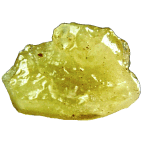 Das libysche Wüstenglas (LDG) ist wohl der bekannteste Vertreter in der Kategorie der Impaktgläser. Dieses besondere Glas ist seltener als Diamanten und Gold. Im Internet werden mittlerweile drei Dollar pro Gramm geboten - für etwas, das aussieht wie Glas. Ein faustgroßes Stück kostet ca. 750 Dollar. Kein Wunder, dass sich sogar Könige damit behängten. Ein geflügelter Skarabäus, Sinnbild des Sonnengottes, schmückte sogar die Brustplatte des ägyptischen Königs Tutanchamun. Die Geschichte beginnt 1930 in Afrika in der libyschen Wüste. Gefunden hatte man das edle Glas schon früher einmal, aber Wüstenforscher Patrick Clayton untersuchte es damals zum ersten Mal wissenschaftlich.
Daten zum Meteorit
| | Name: | Libysches Wüstenglas, LDG (von englisch Libyan Desert Glass) oder LDS(G) (englisch Libyan Desert Silica (Glass)) |
| | Fundjahr: | 1932 |
| | Kontinent: | Afrika |
| | Länder: | Libyen und Ägypten |
| | Region: | Großer Sandsee |
| | Klassifikation: | Impaktit > Impaktglas |
| Libyscher Wüstenglas-Anhänger (Impaktglas | Natura | 925er Silber) - 6,70 g (siehe Beschreibung) |
| Ohne Schmuckkette |
| Echtheitszertifikat |
Wissenschaftliche Arbeiten zum Almahata Sitta Meteorit (Asteroid 2008 TC3) mit unserer Mitwirkung
Publikationen
- Goodrich, F. M. McCubbin, A. Bischoff, S. Decker, and J. W. Boyce: Non-Chondritic Volatile Signatures in a Ureilite Trachyandesite
- Bischoff A., Horstmann M., Barrat J.-A., Chaussidon M., Pack A., Herwartz D., Ward D., Vollmer C., and Decker S., 2014: Almahata Sitta samples MS-MU-001-028: Trachyandesitic volcanism in the early Solar System
- V.H. Hoffmann, K. Wimmer, R. Hochleitner, M. Kaliwoda, M. Funaki, M. Torii, S. Decker: Almahata Sitta Magnetic Susceptibility Database - Update of the Enstatite Chondritic Lithologies
Präsentationen
Poster
- A. Bischoff, M. Horstmann, A. Pack, D. Herwatz, and S. Decker, 2013: Almahata Sitta sample MS-MU-011: A rapidly crystallized basalt from the crust of the ureilite parent body
- A. Bischoff, A.-K. Krämer, K. I. Klemm, and S. Decker, 2018: Almahata Sitta sample MS-MU-039-045: News from the Almahata Sitta strewn field - Seven new samples: Three ureilites, three enstatite chondrites, and one ordinary chondrite
- Viktor H. Hoffmann, R. Hochleitner, M. Kaliwoda, M. Funaki, M. Torii, A. Bischoff, S. Decker: Almahata Sitta samples MS-MU-001-028: Almahata Sitta meteorite - The space "Rosetta" stone
- V.H. Hoffmann, K. Wimmer, R. Hochleitner, M. Kaliwoda, M. Funaki, M. Torii, S. Decker: Almahata Sitta Magnetic Susceptibility Database - Update of the Enstatite Chondritic Lithologies
Abstracts
- V.H. Hoffmann, Hochleitner R., Kaliwoda M., Decker S.: Almahata Sitta samples MS-MU-001-020: Almahata Sitta meteorite - The space "Rosetta" stone
- A. Bischoff, A.-K. Krämer, K. I. Klemm, and S. Decker, 2018: Almahata Sitta sample MS-MU-039-045: News from the Almahata Sitta strewn field - Seven new samples: Three ureilites, three enstatite chondrites, and one ordinary chondrite
- V.H. Hoffmann, M. Kaliwoda, R. Hochleitner, M. Funaki, S. Decker: Almahata Sitta samples MS-MU-001-028: A real space rosetta stone - The Almahata Sitta meteorite
- V.H. Hoffmann, M. Funaki, M. Torii, Hochleitner R., Kaliwoda M., Decker S.: Almahata Sitta samples MS-MU-001-020: A new Almahata Sitta sample set - The story becomes more fascinating
- T. Mikouchi, A. Takenouchi, M. E. Zolensky and V. H. Hoffmann: Almahata Sitta samples MS-MU-011-012: Formation conditions of two unusual rocks from the ureilite parent body
- Bischoff A., Horstmann M., Pack A., Herwatz D., and Decker S., 2013: Almahata Sitta sample MS-MU-011: A rapidly crystallized basalt from the crust of the ureilite parent body
- Bischoff A., Horstmann M., Vollmer C., Heitmann U., and Decker S., 2013: Almahata Sitta samples MS-MU-012-020: New individuals from the Almahata Sitta strewn field: Old friends and brand-new fellows
Weitere wissenschaftliche Arbeiten zum Almahata Sitta Meteorit (Asteroid 2008 TC3)
Publikationen
- Addi Bischoff, Marian Horstmann, Andreas Pack, Matthias Laubenstein and Siegfried Haberer: Asteroid 2008 TC3 - Almahata Sitta: A spectacular Beccia containing many different Ureilitic and Chondritic Lithologies
- Marian Horstmann, Addi Bischoff, Andreas Pack and Matthias Laubenstein: Almahata Sitta-Fragment MS-CH: Characterization of a new Chondrite Type